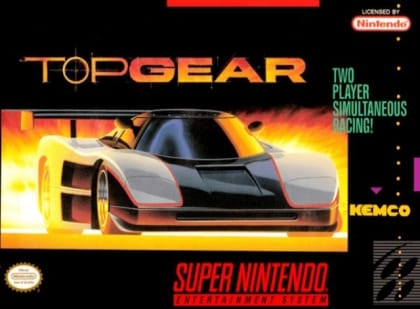
Top Gear
📖 介紹
Top Gear (1992 SNES) racing classic: 16 licensed supercars, split-screen multiplayer, catch-up AI, global circuits. A defining 16-bit racing experience.
Top Gear, released in 1992 for the Super Nintendo, quickly became one of the most acclaimed racing titles of the 16-bit era. Developed by Gremlin Graphics and published by Kemco, it stood out for its impressive roster of 16 licensed supercars from manufacturers like Ferrari, Lamborghini, and Porsche—a rarity for console racing games at the time. The game transported players across six authentic international circuits, each rendered with detailed scenery that captured the essence of real-world locations.
The gameplay centered on realistic handling physics that rewarded skillful driving over button-mashing. Players could accelerate with A, brake with B, and activate the iconic turbo boost with Y. The innovative catch-up AI system kept races competitive by dynamically adjusting opponent speeds, preventing dominant players from pulling too far ahead. The four-button control scheme also included view changes with X and gear shifting with L and R, giving racers full control over their driving experience.
While Top Gear focused primarily on arcade-style racing rather than narrative depth, it established a memorable world through its diverse cast of exotic vehicles and globally inspired tracks. Each car handled differently, encouraging players to master multiple vehicles across varied circuits spanning countries like Italy, Japan, and the United States. The game's atmospheric presentation, combined with Barry Leitch's pumping electronic soundtrack, created an immersive racing environment that defined the era.
Top Gear's impact on the racing genre was profound, spawning multiple sequels and influencing future titles with its split-screen multiplayer and rubber-banding AI mechanics. Its 2-player mode set a new standard for console racing multiplayer, making it a staple at gaming gatherings throughout the 1990s. Decades later, the game remains celebrated for its tight controls, authentic car licenses, and innovative gameplay systems that pushed the boundaries of what 16-bit racing could achieve.